A bicycle collision in Aurora often comes down to one question: what was each person legally required to do when the cyclist’s path and the driver’s path crossed? Those rules often become points of dispute after a crash. An Aurora bicycle accident lawyer investigates which rules applied and how the evidence supports the cyclist’s claim.
Legal The Outlaw Injury Attorneys represents injured cyclists throughout Aurora and the Denver metro area. We handle claims involving unsafe passing, intersection disputes, hit-and-run drivers, and collisions at trail-to-street crossings across Arapahoe and Adams counties. Call (303) 351-2567 any time for a free consultation.
What Colorado Rules Apply When a Cyclist’s Path Crosses a Driver’s?
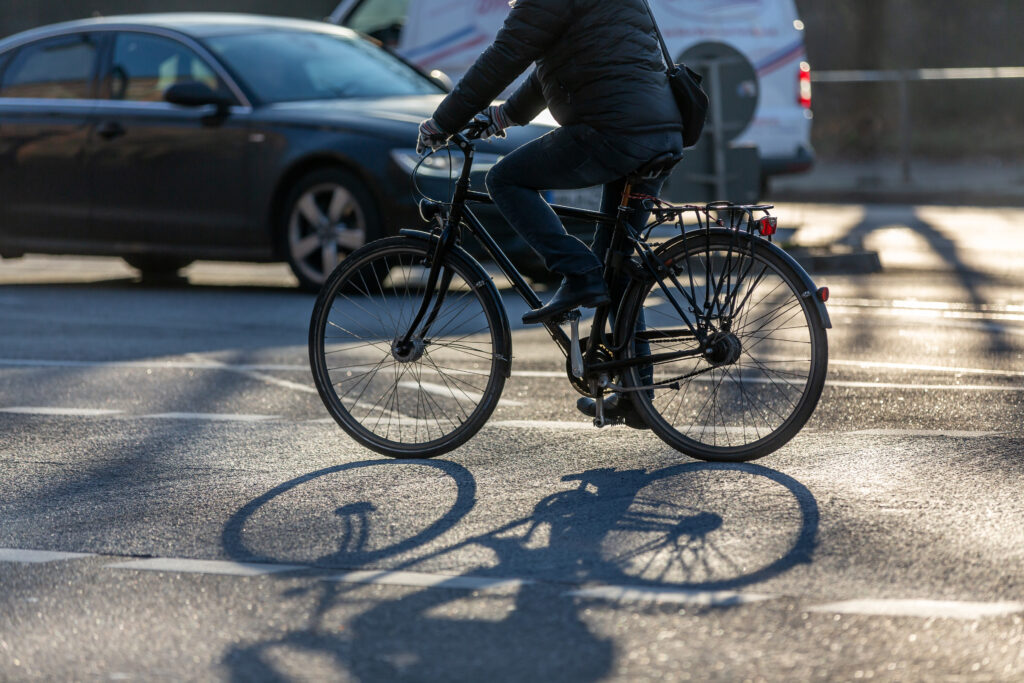
Colorado law gives a person riding a bicycle the rights and duties that generally apply to drivers of other vehicles, subject to bicycle-specific statutes. The specific rules governing passing distance, intersections, and lane use often determine fault when a driver and cyclist dispute who had the right of way.
| Situation | Colorado Rule | Why It Matters to the Claim |
| Passing a cyclist | Motorists must generally provide at least three feet of separation, including mirrors and projections | Helps evaluate close-pass collisions where the vehicle clipped or crowded the rider |
| Stop-sign intersections | Qualifying cyclists may proceed after slowing and yielding when a full stop is unnecessary for safety | Counters the assumption that every rolling bicycle automatically violated the law |
| Red traffic signals | Cyclists must stop and yield before proceeding as the statute permits | Relevant to intersection crashes where the driver claims the cyclist ran the light |
| Bike-lane obstruction | State law generally prohibits stopping, standing, or parking in a designated bike lane, subject to exceptions | Relevant when a vehicle in the lane forces a rider into traffic |
How Close May a Driver Legally Pass a Bicycle?
Colorado requires motorists overtaking a bicycle to maintain at least three feet of separation, including mirrors and other vehicle projections. A close-pass collision raises a direct question about whether the driver met that standard.
Physical evidence often clarifies the answer. Damage to the bicycle’s left side, a vehicle’s passenger mirror, or road markings showing the rider’s position may all indicate how much space the driver actually left. A three-foot violation does not automatically determine civil liability, but it provides an important benchmark for evaluating the driver’s conduct.
Does Colorado’s Safety-Stop Law Affect Fault?
Colorado’s bicycle safety-stop law allows cyclists aged 15 and older to treat a stop sign as a yield under specific conditions. The rider must slow to a reasonable speed of 10 mph or less, yield to approaching traffic and pedestrians, and stop when safety requires it. At a red signal, the cyclist must first stop and yield before proceeding as the statute permits.
Drivers and insurers sometimes argue that a cyclist “ran” a stop sign. If the cyclist followed the safety-stop procedure, that argument loses its foundation. The evidence at the intersection, including the cyclist’s speed, sight lines, and actual conduct, determines whether the law was followed.
What Happens When a Vehicle Blocks a Bike Lane?
Colorado HB26-1237 generally prohibits stopping, standing, or parking a motor vehicle in the roadway portion designated as a bike lane. Specific exceptions exist under the statute.
When a stopped vehicle forces a cyclist to leave a designated lane and merge into traffic, the question becomes whether the vehicle’s presence contributed to the collision. The statute does not make every vehicle found near a bike lane automatically liable, but it establishes a standard for evaluating the driver’s or parked vehicle’s role in the crash.
How Does Disputed Right-of-Way Affect an Aurora Bicycle Injury Claim?

Colorado follows a modified comparative negligence system under C.R.S. § 13-21-111. When the injured cyclist bears some share of fault, the cyclist’s recovery is reduced by that percentage. Recovery is barred entirely if the cyclist’s fault reaches 50 percent or more against a given defendant.
That rule becomes the center of the personal injury case when an insurer assigns partial fault to the cyclist. The allegation might involve lane position on Chambers Road, a failure to signal before turning, or riding without required lighting after dark. Each allegation requires evidence showing what actually happened at the collision point.
Colorado’s jury instructions also distinguish the cyclist’s own comparative fault from the allocation of responsibility among multiple drivers or other parties. Those are separate questions with different consequences for what each insurer owes.
What Fault Allegations Do Cyclists Face After an Aurora Collision?
Insurers reviewing bicycle claims sometimes argue the cyclist contributed to the crash. The allegations typically fall into a few categories of conduct:
- Riding outside a designated bike lane when one was available
- Failing to signal a turn or lane change
- Entering an intersection against a traffic signal
- Lacking required lighting or reflectors during low-visibility conditions
- Riding unpredictably near traffic
None of these allegations automatically establishes fault. Colorado’s comparative negligence analysis considers the full circumstances, including what the driver was required to do. An Aurora bike accident attorney reviews the physical evidence and applicable rules before accepting or contesting any fault allocation.
What Insurance Applies When a Hit-and-Run Driver Injures a Cyclist?
A cyclist struck by a driver who leaves the scene faces two problems at once: identifying the driver and finding a source of compensation. When the driver remains unknown or carries no insurance, the cyclist’s own automobile policy may provide a path forward through uninsured motorist coverage.
Colorado’s UM statute protects insured persons who are legally entitled to recover damages from uninsured motorists, subject to the policy and statutory terms. That protection may extend to a person injured while riding a bicycle, not only while driving the insured vehicle.
Does Your Own Auto Policy Cover Bicycle Collisions?
UM/UIM coverage under a cyclist’s own auto policy may apply even though the cyclist was on a bicycle at the time of the crash. Whether that coverage extends to the collision depends on the specific policy language and Colorado’s statutory framework.
A cyclist injury lawyer in Aurora, CO, reviews every potentially applicable insurance policy early in the claim. UM/UIM claims also carry their own statutory timing provisions under C.R.S. § 13-80-107.5, separate from the underlying motor-vehicle deadline. Missing that separate deadline may eliminate an otherwise valid source of recovery.
Why Choose Legal The Outlaw Injury Attorneys as Your Bicycle Crash Lawyer in Aurora?
Bicycle injury claims turn on details that general personal injury practice does not always emphasize. Our team compares cycling-device data with physical impact evidence, examines lane markings and collision geometry, and applies Colorado’s bicycle-specific statutes to determine what each road user was required to do at the point of the crash.
When the driver leaves or carries insufficient coverage, we evaluate every potentially applicable UM/UIM policy before accepting an insurer’s position on available coverage. Attorney Ross Ziev, recognized by Best Lawyers and Super Lawyers, leads the team from our Greenwood Village office.
We take bicycle injury cases on a contingency fee basis and offer free consultations 24/7. Call (303) 351-2567.
Past results do not guarantee future outcomes.
What Evidence Strengthens an Aurora Bicycle Accident Claim?
The evidence that matters most in a bicycle collision connects the rider’s position, speed, and direction to the driver’s conduct at the point of impact. Digital cycling records and physical damage evidence together help establish where the crash happened and how each road user approached the collision.
Several categories of records support that analysis when they are available:
- Cycling-computer or GPS route data showing the rider’s speed, direction, and location before impact
- Helmet-camera or bicycle-mounted camera footage
- Bicycle damage and the specific point of impact on the frame, wheel, or components
- Vehicle damage to mirrors, doors, or panels consistent with a side-impact collision
- Aurora Police Department crash report and officer observations
- Traffic or business surveillance footage near the collision location
Cycling-device data, surveillance footage, and roadway conditions at the collision site may all change or become unavailable as weeks pass. A bicycle crash lawyer in Aurora, Colorado, works to preserve this material early.
How Does Cycling Device Data Support a Claim?
GPS-enabled cycling computers and fitness apps record route data that may include timestamps, speed, elevation, and geographic coordinates. When compared with the physical evidence at the collision site, this data helps reconstruct the moments before impact.
A rider’s device might show steady speed along East Alameda Parkway followed by an abrupt stop consistent with a collision. That digital record, paired with bicycle damage and road markings, helps establish what each road user was doing when their paths crossed.
What Compensation May a Cyclist Pursue After an Aurora Collision?

Cycling injuries frequently involve broken bones, road rash requiring wound care, head injuries, and joint damage that limits mobility well beyond the initial recovery. Colorado allows injured claimants to pursue both economic and non-economic damages.
For civil actions filed on or after January 1, 2025, the general noneconomic damages cap is $1.5 million, with inflation adjustments beginning in 2028.
A bicycle accident claim may include several different types of losses. Colorado distinguishes economic damages, noneconomic damages, property losses, and physical impairment or disfigurement, which the state’s civil jury instructions treat as a separate damage category:
- Emergency treatment, surgery, physical therapy, and follow-up care
- Lost wages during recovery and reduced earning capacity for long-term injuries
- Bicycle replacement or repair, along with damaged helmets, cycling computers, and gear
- Pain, emotional distress, and other non-economic losses
- Physical impairment or disfigurement, evaluated as a distinct category under Colorado law
Each loss requires supporting records that connect the injury to the collision and document the financial and personal impact over time.
Where in Aurora Do Bicycle and Vehicle Routes Intersect?
Aurora maintains a bicycle and pedestrian network that includes the High Line Canal Trail, Toll Gate Creek Trail, and Piney Creek Trail, along with on-street bicycle facilities. Several of these routes cross or connect with roads like Chambers Road, East Colfax Avenue, and East Alameda Parkway.
The legal question at any trail-to-street crossing is what each road user was required to do at that transition point. A cyclist leaving the High Line Canal Trail and entering a street crossing follows different rules than a cyclist already established in a travel lane.
How Long Do You Have to File a Bicycle Accident Claim in Aurora?
A bicycle collision caused by a motor vehicle generally falls within Colorado’s three-year statute of limitations for motor vehicle injury claims. Not every bicycle claim follows the same timeline. UM/UIM claims, government-entity claims, and other theories of recovery may carry different deadlines.
The practical concern for cyclists is that key evidence, including device data, surveillance footage, bicycle condition, and roadway markings, may become unavailable well before the filing deadline arrives.
When Does an Aurora Bicycle Crash Call for a Lawyer?
An attorney adds the most value in a bicycle claim when the dispute centers on which traffic rule applied at the collision point and the insurer contests the cyclist’s account.
A driver who claims the cyclist entered the intersection improperly, an insurer who argues the rider left a bike lane without justification, or a hit-and-run situation requiring UM/UIM investigation all create disputes that are difficult to resolve without legal training and access to the relevant records.
When the crash caused fractures, a head injury, or other damage requiring months of treatment, the compensation question also extends beyond current medical bills into future care and lost earning capacity.
Our Aurora personal injury attorneys review the cycling data, physical evidence, Colorado bicycle statutes, and every applicable insurance policy to build the claim. We also handle Colorado bicycle accident claims and cases involving pedestrian accidents throughout the Denver metro area.
FAQs for Aurora Bicycle Accident Claims
Am I Automatically at Fault If I Was Riding Outside a Bike Lane?
No. Colorado law does not require cyclists to ride in a bike lane at all times. A cyclist may leave a lane to avoid debris, parked vehicles, or other hazards. An insurer arguing that the rider’s lane position caused the crash must still prove that the position actually contributed to the collision.
What If I Was Riding an E-Bike When the Driver Hit Me?
E-bike riders may pursue injury claims after a motor-vehicle collision. Colorado classifies e-bikes into three categories based on motor type and maximum assisted speed. The classification affects where certain e-bikes may operate but does not eliminate the driver’s duties under Colorado traffic law.
Does It Matter If I Was Not Wearing a Helmet?
Helmet use does not determine who caused the collision. No Colorado law requires adult cyclists to wear helmets. An insurer may still argue that the absence of a helmet contributed to head-injury severity. Whether that argument affects the damages analysis depends on the specific facts.
What If Multiple Vehicles Were Involved in the Collision?
A cyclist may pursue claims against more than one at-fault driver. Colorado allocates fault among all responsible parties. What each driver’s insurer pays depends on both the percentage of fault assigned to that driver and the terms of the applicable coverage.
Talk to an Aurora Bicycle Accident Lawyer About Your Collision

Determining which traffic rule governed the moment a driver and cyclist crossed paths takes more than a police report. Legal The Outlaw Injury Attorneys reviews the cycling data, physical evidence, and applicable Colorado bicycle statutes to build the strongest case the facts support.
We take bicycle injury cases on a contingency fee basis, meaning you owe no attorney fees unless we recover compensation for you. Contact us for a free consultation, or call (303) 351-2567 any time.